What counts as a hybrid here
Toyota Hybrid history contains several ways to combine an engine, an electric motor and energy storage. A Prius can send engine power to the wheels mechanically and through an electrical path. The 1997 Coaster Hybrid EV uses electric traction while its gasoline engine generates electricity. The early Crown THS-M assists its engine with a belt-driven motor-generator. Their capabilities differ even though all carry the hybrid name. [5] [10] [9]
HEV denotes a hybrid without plug-in charging; PHEV, also called PHV in older Toyota material, accepts external electricity. That describes energy supply. Series, parallel and series-parallel describe power transmission. A larger battery or a long EV mode does not by itself make a vehicle a series hybrid. Production Prius PHV and RAV4 PHEV retain a mechanical engine-to-wheel power path. [18] [41]
EREV commonly describes an electric vehicle with a range extender. The Coaster resembles that idea in its electric traction, but Toyota called it a series hybrid and explicitly stated that separate charging was unnecessary. This article preserves that historical classification. Hydrogen FCEVs form a separate branch: a fuel cell works with a battery, without a gasoline engine. [5] [31]
Series: 1997 Coaster
The motor drives the wheels. A battery connects to the electrical circuit and accepts regenerated energy.
Series-parallel: Prius
The engine has mechanical connections to the wheels and generator. Generator, motor and battery provide an electrical path. This is a connection diagram, not one operating state.
Parallel: Tundra i-FORCE MAX
A motor-generator and clutch sit between the engine and automatic transmission; the battery supplies the motor and accepts regeneration.
1991–1995: buses and the G21 project
Commercial vehicles had their own early history. Hino put the HIMR urban hybrid bus on sale in 1991. Calling it a Toyota-branded vehicle retrospectively would be misleading: Hino dates its becoming a Toyota subsidiary to 2001. This is group context, rather than an early Prius generation. [12]
Toyota started G21 in 1993 as a project for a twenty-first-century car. Its initial goal was 1.5 times the fuel economy of a conventional vehicle; management subsequently demanded twice the economy. Hybrid propulsion was chosen during development rather than being part of the original brief. G21 involved much more than replacing one engine with another. [2]
The 1995 Prius concept used EMS: a 1.5-liter D-4 gasoline engine, belt CVT, induction motor-generator and capacitor. Regeneration and engine stop were already part of the design, but the production Prius planetary mechanism was absent. A September release announced its Frankfurt appearance on September 16–24, followed by Tokyo. Its public history therefore reaches back before October 1995. [4] [2]
Coaster Hybrid EV: a Toyota hybrid before Prius
On October 14, 1994 Toyota announced a prototype Coaster Hybrid EV. A 1.3-liter gasoline engine generated electricity while an electric motor rated at up to 70 kW propelled the bus. Batteries absorbed surplus energy and supported higher demand. The release described development and future practicality testing, rather than a sales launch. [3]
The production Coaster Hybrid EV arrived on August 22, 1997, almost four months before Prius sales began. It used a 1.5-liter gasoline engine. Generated electricity supplied the traction motor or charged the battery, while regenerative braking recovered some deceleration energy. Separate charging was unnecessary. Toyota quoted 400–500 km between fuel stops; that is not an electric range measured on a modern test cycle. [5]
Tokyo prices were ¥14 million for LX and ¥14.5 million for EX. The initial sales territory excluded Hokkaido. The photograph below shows a bus at Hoheikyo Dam in Hokkaido in 2008: the 1997 release's territorial restriction does not describe the entire subsequent operating history. [5]


Factory statistics show how rare it was: cumulative sales reached 56 Coaster Hybrids by the end of March 2002, against 89,091 Prius cars. This is an interim count, not the Coaster's lifetime production. Toyota's later chronology dates the end of production to 2004 and groups commercial hybrids together in its statistics, preventing extraction of a final model-specific total. [7] [11]
1997–2023: five Prius generations
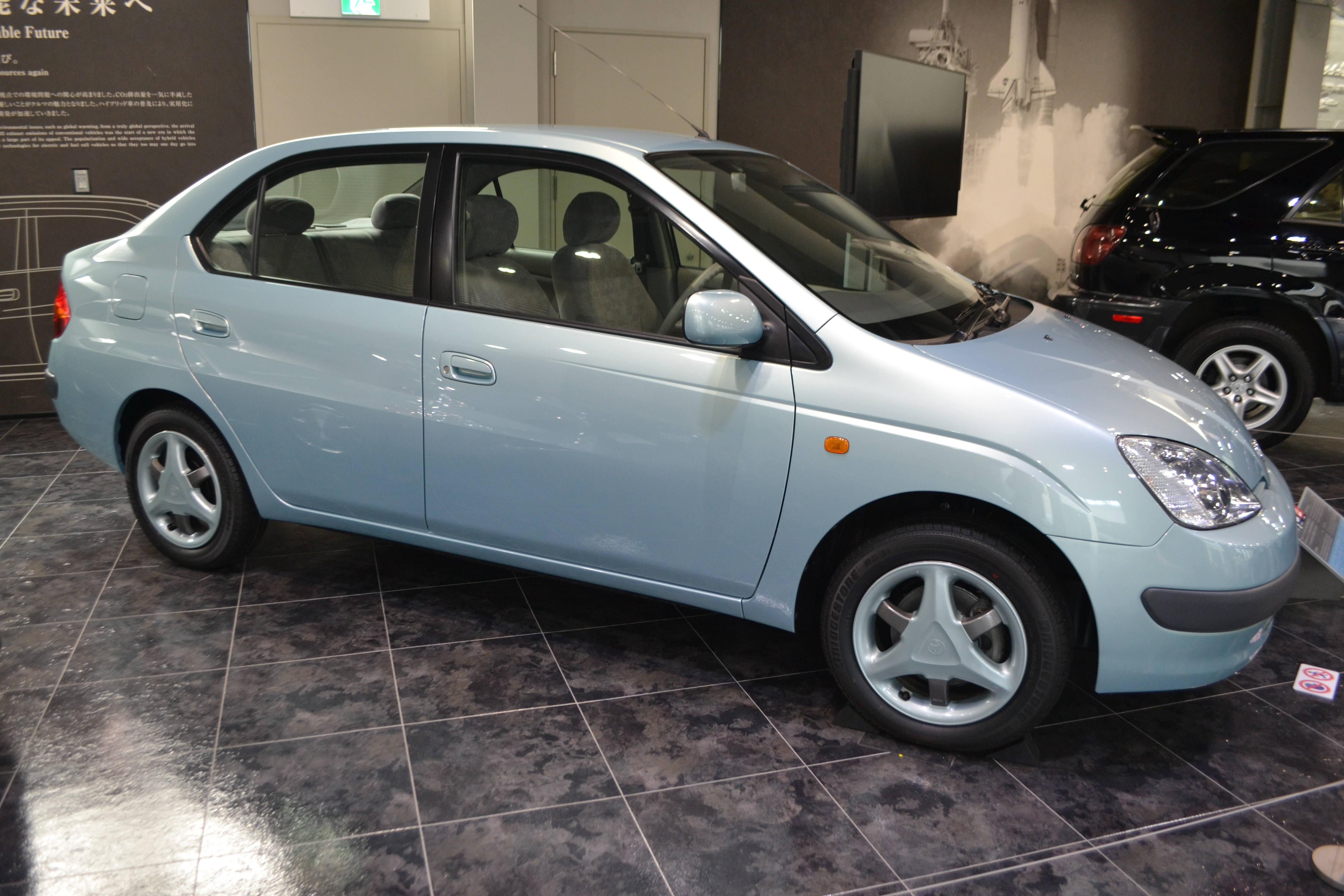
Toyota presented the production Prius on October 14, 1997; Japanese sales began on December 10. THS combined a 1.5-liter 1NZ-FXE engine, electric machines and a traction battery. A planetary gearset divided power, with electronic control providing continuously variable behavior without the EMS concept's belt CVT. The starting price was ¥2.15 million. [6] [10]
The original car's quoted 28 km/L belonged to Japan's 10–15 cycle. It cannot be compared directly with later JC08, WLTP or EPA results. Overseas expansion in 2000 came with revisions within the first generation. John1701a preserves an account of online advance orders and U.S. deliveries. His Original, Classic and Iconic labels help readers navigate that archive but do not replace conventional generation numbering. [6] [1] [11]
In April 2003 Toyota introduced THS II under the Hybrid Synergy Drive concept. A boost converter allowed up to 500 V in the motor circuit; this did not mean a 500 V battery. The second-generation liftback followed that September. The third generation arrived in 2009 with a 1.8-liter engine and a redesigned system including separate traction-motor speed reduction. [10] [11] [13]
The fourth generation launched in Japan in December 2015 with TNGA, reduced losses and available E-Four. Toyota unveiled the fifth Prius in November 2022; Japanese HEV sales began in January 2023 and PHEV sales in March. The “60” family remains the fifth generation. The powertrain guide covers its mechanisms and model codes. [14] [15] [20]

2001–2006: Estima, Crown and commercial vehicles
The 2001 Estima Hybrid demonstrated a different route. THS-C used a belt CVT at the front and a separate E-Four rear motor. A 100 V AC outlet supplying up to 1,500 W was already available. The first Alphard Hybrid in 2003 also used THS-C. Sharing the Hybrid badge did not make these early minivans technical copies of a Prius. [8] [9]
The Crown Royal gained THS-M mild-hybrid propulsion in August 2001; the Crown Sedan followed in October 2002. A belt-driven motor-generator replaced the conventional alternator, assisted take-off and recovered braking energy. Documentation describes both a 42 V electrical system and a 36 V battery: these are different ratings within one installation. The full Crown Hybrid launched in 2008 belongs to another branch. [9] [11]
Dyna Hybrid and Toyoace Hybrid arrived in November 2003. The Dyna combined a 4-liter common-rail diesel with a parallel hybrid system. Toyota's chronology records the hybrid Quick Delivery 200 in October 2006; production of that hybrid version ended in 2012. Diesel trucks, the gasoline series-hybrid Coaster and the passenger Prius addressed different tasks and cannot all be treated as one e-CVT family. [9] [11]
2005–2021: the hybrid becomes a mainstream option
Hybrid power reached the Harrier/Lexus RX 400h and Kluger/Highlander in 2005. The Lexus GS 450h and Camry Hybrid followed in 2006, the LS 600h in 2007, and the HS 250h and Toyota Sai in 2009. Hybrids now served family crossovers, a mainstream sedan and luxury cars. These dates follow Toyota's factory chronology; names and actual market arrival dates varied by region. [11]
The Auris Hybrid expanded the European offering in 2010. The Prius α, called Prius v or Prius+ in other markets, and compact Aqua/Prius c arrived in 2011; the European Yaris Hybrid followed in 2012. Japan's Corolla Axio sedan and Fielder wagon gained hybrids in August 2013. Hybrid propulsion increasingly became a choice within a familiar model family. [11] [22]
| Event year | Model | What changed |
|---|---|---|
| 2016 | C-HR | Japan, 1.8-liter THS II; turbo separate [44] |
| 2020 | Corolla Cross | Thailand, launch with a hybrid option [45] |
| 2020 / MY2021 | Sienna | U.S., every grade of the new model is a hybrid [46] |
| 2021 | Lexus NX 450h+ | Premiere of the first Lexus PHEV [47] |
| 2023 | Land Cruiser 250 | Premiere, 2.4-liter turbo hybrid / 8AT for selected markets [49] |
| 2024 | Tacoma i-FORCE MAX | U.S., 2.4-liter turbo hybrid / 8AT [48] |
| 2026 | Land Cruiser 300 | 3.5-liter V6 parallel hybrid / 10AT; selected markets [50] |
| 09.2026 | Lexus NX | Updated model premiere; sales planned from late 2026 [51] |
The second-generation Aqua in 2021 introduced a bipolar nickel-metal hydride battery in grades above B. Bipolar describes its construction; it does not turn NiMH into lithium-ion or solid-state chemistry. Its use in the Aqua also does not mean every Toyota of that year received it. [23]
Special-purpose cars had their own reasons for hybridization. The 2017 JPN TAXI uses LPG, liquefied petroleum gas. The 2018 Century sedan adopted a 5.0-liter V8 hybrid. The taller 2023 Century instead uses a 3.5-liter V6 plug-in hybrid and exists separately from the sedan. [30] [24] [25]
2007–2026: the plug-in branch
The first experimental plug-in Prius cars were different from the production PHV familiar from 2012. In July 2007 Toyota received Japanese road-test certification for the Plug-in HV and announced eight vehicles. They used an enlarged NiMH battery; their 13 km electric range was measured on the 10–15 cycle. In December 2009 Toyota announced an international program of roughly 600 third-generation-based cars with a 5.2 kWh lithium-ion battery. [16] [17]
The production Prius PHV launched in Japan on January 30, 2012 with 4.4 kWh. The 2017 model brought 8.8 kWh, both electric machines contributing traction in EV mode, and Japanese-market quick charging. An optional solar roof could now charge the traction battery. The 2023 Prius PHEV increased nominal battery energy to 13.6 kWh. These figures describe total nominal energy, rather than the entire usable charge available to the driver. [18] [19] [20]
The plug-in branch spread beyond Prius. Japan's 2020 RAV4 PHEV combined a 2.5-liter engine, E-Four and 225 kW system output. Its 95 km electric range was a Japanese WLTC result. Six-seat Alphard and Vellfire plug-ins followed in 2025. Quiet stationary operation and engine-off travel also suited larger passenger vehicles. [21] [40]
Toyota announced a March 9, 2026 Japanese launch for the new RAV4 PHEV, following the HEV in December 2025. It retains a series-parallel layout with the 2.5-liter A25A-FXS, e-CVT and E-Four, while adding 242 kW output and SiC power electronics. The February release labels approximately 150 km electric range as Toyota's internal measurement. It must not be presented as EPA range or compared directly with the earlier 95 km WLTC result. [41]
Electric driving followed by an engine start does not establish an EREV architecture. These Prius and RAV4 models can operate as series-parallel hybrids after using the plug-in portion of their stored energy. The charging guide covers charging and market differences in more detail. [19] [41]
Hybrids with stepped transmissions and 48 V systems
The 2017 Lexus LC 500h introduced Multi Stage Hybrid, adding a stepped transmission to the hybrid unit. It must be distinguished from the V8 LC 500 with its conventional ten-speed automatic. Even within one model family, transmission design and behavior depend on the powertrain. [26]
In the model-year 2022 Tundra, i-FORCE MAX places a motor-generator and clutch between a twin-turbo V6 and a ten-speed automatic. This parallel hybrid supports electric driving, regeneration and engine assistance. The 2022 Crown Crossover introduced two different systems: a 2.5-liter series-parallel hybrid and a 2.4-liter turbo hybrid with a six-speed automatic and rear eAxle. Calling all of them a “Prius CVT” is inaccurate. [27] [28]
The European-specification 2024 Hilux Hybrid 48V combines a 2.8-liter diesel, belt-driven motor-generator and small lithium-ion battery. It is a mild hybrid: electrical assistance and regeneration do not provide Prius-like electric driving. Returning to a belt motor-generator decades after the Crown THS-M reflects a different design choice for a different vehicle, rather than a single generation sequence for Toyota Hybrid. [29] [9]
FCHV, Mirai and Sora: a separate branch
Toyota also applied hybrid technology without a gasoline engine. Limited FCHV deployment in Japan and the United States began in December 2002. A fuel cell generated electricity from hydrogen, with a battery supporting energy management. The Mirai reached the Japanese market in December 2014. Early references to a fuel cell hybrid describe the combination of a fuel cell and energy storage. [9] [31]
The first production Sora bus went on sale on March 7, 2018. On October 5, 2026 Toyota launched a new Sora jointly developed with Isuzu: Isuzu's full-flat-floor BEV bus platform is combined with Toyota's fuel-cell system and a battery. This continues the electric public-transport branch with a different vehicle and partner. [32] [33]
These vehicles are FCEVs. Their place in hybrid-technology history follows from combining an electricity source with a battery; they do not belong in a list of gasoline HEVs or PHEVs. Using hydrogen also does not imply a hydrogen internal-combustion engine. [31] [33]
Concepts and racing
Experiments explored several directions. The 2007 FT-HS examined a sporting hybrid with a 3.5-liter V6. The compact FT-CH appeared in Detroit in January 2010. The 2012 FT-Bh combined a 1.0-liter two-cylinder gasoline engine, THS II and a lithium-ion battery; Toyota quoted 2.1 L/100 km NEDC for the 786 kg concept. Proposed CNG and plug-in alternatives were not production variants. [36] [37] [38]
The 2001 ES3 combined a 1.4-liter diesel, CVT, stop-start and regeneration. Those features in the release do not establish full electric traction. It is included as an example of transferring individual technologies, rather than as another confirmed full hybrid. [39]
On track, a Lexus GS 450h competed at Tokachi 24h in 2006. The Supra HV-R won the event outright in 2007, using a supercapacitor, rear motor-generator and two front electric machines to recover and reuse braking energy. The 2012 TS030 and subsequent TS040 continued the capacitor approach; the 2016 TS050 switched to lithium-ion storage. This racing system was not transferred wholesale into the road-going Prius. [34]
Toyota's first Le Mans victories came with the TS050 in 2018–2020 and GR010 in 2021–2022. In December 2025 Toyota unveiled the road-car GR GT prototype, combining a 4.0-liter twin-turbo V8, a single rear-transaxle motor and an eight-speed automatic. Launch was targeted for around 2027; at this article's cutoff it remains a project, not a production hybrid sold in 2026. The accompanying GR GT3 cannot automatically be labeled a hybrid. [35] [42]
How the scale changed
The chart shows selected points from one factory series of annual worldwide Toyota/Lexus hybrid sales published in 2017. Values are in thousands of vehicles and include plug-in hybrids. Cumulative sales passed 10 million in January 2017. The chart stops at 2016; it represents neither today's total nor a forecast for the end of 2026. [11]
Data and method
| Year | Thousand vehicles |
|---|---|
| 1997 | 0.3 |
| 2001 | 36.9 |
| 2005 | 234.9 |
| 2010 | 690.2 |
| 2016 | 1400.6 |
The technology also spread through licensing. In 2019 Toyota announced royalty-free licenses covering approximately 23,740 electrification patents, including pending applications, through the end of 2030. This was a licensing program with conditions, rather than a release of the technology into the public domain. [43]
How to read this history
This reference covers Toyota's and Lexus's main technical branches and related commercial projects from the early 1990s to October 16, 2026. It is a history of systems and representative models, rather than a catalog of every grade and regional rebadge. Reveal dates, sales launches and model years are distinguished; concepts, experimental fleets and racing cars are labeled separately.
John1701a's original chronology preserves early Prius context and the first buyers' experience. Separate Toyota, Lexus and Hino publications establish factory dates and designs. The PNGV narrative is not treated as an established explanation for G21's origin; the W/kg table is not used as a battery-energy table. Photographs have their own attribution, while the diagrams and chart were created for this article. [1] [2]
By 2026 the hybrid name spans series-parallel HEVs and PHEVs, systems with conventional automatic transmissions, mild 48 V systems and a separate hydrogen branch. The historic Coaster shows that Toyota used series electric traction long before today's interest in range extenders. Each architecture retains its own energy sources and mechanical connections. [5] [27] [29] [41] [33]
Sources and scope
Numbers follow bibliography order. Primary releases establish manufacturer statements; quoted range and development targets do not replace independent tests. Each entry identifies the sections used.
- John1701a: Prius History. 2008-12-07. 1993; October 1995; June–August 2000; 2003. Accessed October 16, 2026.
- Prius concept car (1995). 2017-08-04. G21 introductory paragraphs; TOYOTA EMS. Accessed October 16, 2026.
- Toyota Develops Hybrid Electric Bus. 1994-10-14. Features 1; reference specifications. Accessed October 16, 2026.
- Prius concept at Frankfurt Motor Show. 1995-09-07. Opening; EMS description. Accessed October 16, 2026.
- Toyota Begins Sales of Coaster Hybrid Electric Vehicle. 1997-08-22. Opening; Traveling Distance; prices. Accessed October 16, 2026.
- Toyota Launches the Revolutionary PRIUS. 1997-10-14. Opening; Outstanding Fuel Efficiency; Sales Information. Accessed October 16, 2026.
- Toyota Worldwide Hybrid Sales Top 100,000 Mark. 2002-04-22. Cumulative Toyota hybrid vehicle sales table. Accessed October 16, 2026.
- Estima Hybrid: Gleaming Example of Automotive Evolution. 2001-06-15. Opening; Revolutionary Minivan technologies. Accessed October 16, 2026.
- Shoichi Sasaki: The History of Hybrid Technology in Toyota. 2005-11. §2.2–2.8, PDF pp.12–15 / printed pp.11–14; figures 6/10/12/15. Accessed October 16, 2026.
- Toyota Develops New Hybrid System. 2003-04-17. THS II highlights; high-voltage system. Accessed October 16, 2026.
- Worldwide Sales of Toyota Hybrids Surpass 10 Million Units. 2017-02-14. Hybrid chronology; annual sales; model table footnotes. Accessed October 16, 2026.
- History of Hino. Undated. 1991; 2001; 2003. Accessed October 16, 2026.
- Toyota Launches Third-generation Prius. 2009-05-18. Opening; environmental performance; THS II. Accessed October 16, 2026.
- Japan Launch Marks Start of Journey for Dynamic New Prius. 2015-12-09. Opening; TNGA; E-Four. Accessed October 16, 2026.
- World Premiere of All-New Prius in Japan. 2022-11-16. Opening; Vehicle details §2. Accessed October 16, 2026.
- Japan Certifies Toyota Plug-in Hybrid for Public-road Tests. 2007-07-25. Opening; main specifications. Accessed October 16, 2026.
- TMC Introduces Prius Plug-in Hybrid into Key Markets. 2009-12-14. Opening; hybrid system specifications. Accessed October 16, 2026.
- Orders for Soon-to-be-launched Prius PHV. 2011-11-29. Opening; specifications. Accessed October 16, 2026.
- Toyota Launches Redesigned Prius PHV in Japan. 2017-02-15. Vehicle outline §1; specifications; charging. Accessed October 16, 2026.
- Toyota Launches All-New Prius PHEV in Japan. 2023-03-01. Opening; vehicle outline. Accessed October 16, 2026.
- Toyota Launches New Model RAV4 PHEV. 2020-06-08. Opening; vehicle outline; footnotes. Accessed October 16, 2026.
- TMC Launches Corolla Hybrids in Japan. 2013-08-06. Opening; hybrid system. Accessed October 16, 2026.
- Toyota to Launch All-New Aqua. 2021-07-19. Opening; high-output bipolar battery. Accessed October 16, 2026.
- Toyota Rolls Out First Fully Redesigned Century in 21 Years. 2018-06-22. Opening; powertrain. Accessed October 16, 2026.
- Toyota to Launch New Century in Japan. 2023-09-06. Vehicle overview §3; specifications. Accessed October 16, 2026.
- Lexus Launches the New LC Luxury Coupe. 2017-03-16. Multi-stage hybrid system; pricing table. Accessed October 16, 2026.
- All-New 2022 Toyota Tundra. 2021-11-05. i-FORCE MAX powertrain. Accessed October 16, 2026.
- World Premiere of the All-New Crown Series. 2022-07-15. 2.4-liter Turbo Hybrid System; 2.5-liter Series Parallel. Accessed October 16, 2026.
- The new Toyota Hilux Hybrid 48V. 2024-09-13. 48V hybrid system. Accessed October 16, 2026.
- Toyota launches JPN TAXI. 2017-10-23. Opening; LPG hybrid system. Accessed October 16, 2026.
- Toyota Ushers in the Future with Launch of Mirai. 2014-11-18. Opening; Toyota Fuel Cell System. Accessed October 16, 2026.
- Toyota Launches Production Model Sora FC Bus. 2018-03-28. Opening; main specifications. Accessed October 16, 2026.
- Toyota Launches New Fuel Cell Route Bus Sora. 2026-10-05. Opening; Vehicle Overview §1. Accessed October 16, 2026.
- History of Toyota Hybrid System-Racing. 2017-08-04. 2006 GS450h; 2007 Supra HV-R; 2012 TS030; 2016 TS050. Accessed October 16, 2026.
- Toyota Gazoo Racing Opens Le Mans Special Website. 2023-05-25. Five winning cars caption; introduction. Accessed October 16, 2026.
- FT-HS at North American International Auto Show. 2007-01-08. Opening; main specifications. Accessed October 16, 2026.
- Compact Hybrid Concept Car at Detroit Show. 2010-01-12. Opening; vehicle table. Accessed October 16, 2026.
- Next-generation Toyota Small Hybrid Concept. 2012-03-06. Vehicle outline; main specifications. Accessed October 16, 2026.
- Toyota Displays Earth-friendly ES3 Concept. 2001-09-12. Powertrain paragraph. Accessed October 16, 2026.
- Toyota Launches Alphard and Vellfire PHEV Models. 2024-12-20. Opening; price tables; overview. Accessed October 16, 2026.
- Toyota Launches New RAV4 PHEV in Japan. 2026-02-19. Opening; Vehicle Outline §1; footnote 3. Accessed October 16, 2026.
- TGR World Premieres GR GT and GR GT3. 2025-12-05. Opening; main specifications; development schedule. Accessed October 16, 2026.
- Toyota Provides Nearly 24,000 Licenses Royalty-Free. 2019-04-03. Opening; grant period; technical support. Accessed October 16, 2026.
- Toyota Launches the New C-HR. 2016-12-14. Opening / powertrain specifications. Accessed October 16, 2026.
- Toyota Unveils Corolla Cross in Thailand. 2020-07-09. Opening / powertrain specifications. Accessed October 16, 2026.
- Toyota Launches All-New 2021 Sienna. 2020-05-18. Opening / powertrain specifications. Accessed October 16, 2026.
- All-New Lexus NX Premieres. 2021-06-12. Opening / powertrain specifications. Accessed October 16, 2026.
- 2024 Toyota Tacoma with i-FORCE MAX. 2024-04-23. Opening / powertrain specifications. Accessed October 16, 2026.
- Toyota New Land Cruiser 250 World Premiere. 2023-08-02. Opening / powertrain specifications. Accessed October 16, 2026.
- Land Cruiser 300 Performance Hybrid. 2026-01-15. Opening / powertrain specifications. Accessed October 16, 2026.
- Lexus Unveils the New NX in a World Premiere. 2026-09-01. Opening / powertrain specifications. Accessed October 16, 2026.